
Cash Flow vs Profit: Why Your Dental Practice Bank Balance Doesn’t Match Your Bottom Line


Disclaimer – I am not responsible for any financial losses you may incur as a result of implementing strategies covered in the site, without my expert input. For full disclaimer check out our internal process
Table of Contents
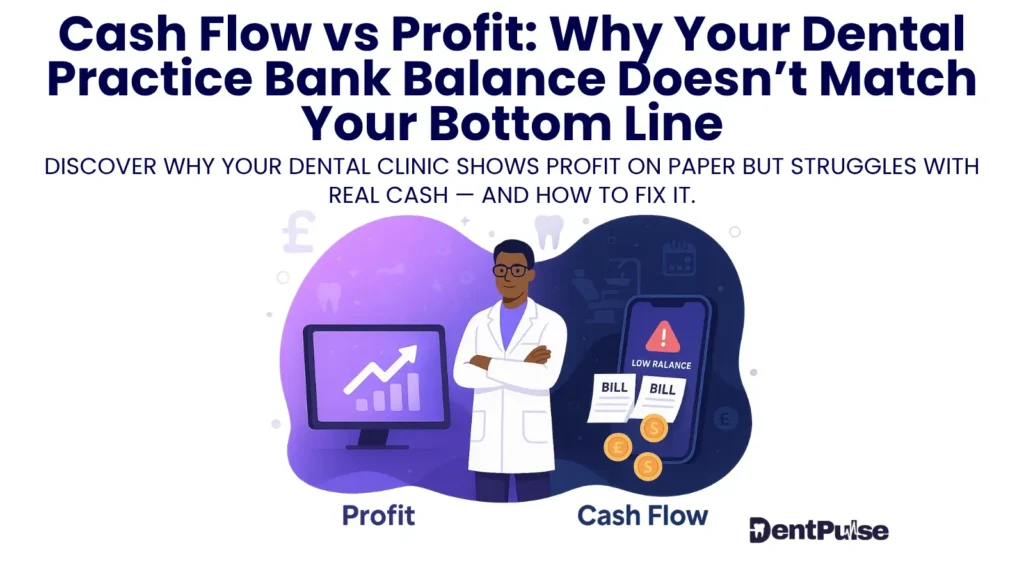
As a dental practice owner, you’re working hard. Production is up. The P&L in Xero shows you made a profit.
But you log into your mobile banking app… and there’s barely enough to pay the next corporation tax bill.
If you are still with me, you’re not alone.
As a Chartered Certified Accountant and Dental CFO for over 67 dental practices across the UK, I’ve helped NHS, mixed, and private practice owners decode the silent leaks between profit and cash — and design growth that’s actually fundable.
From six-figure clinics to multi-site £3M groups, the pattern is always the same:
You don’t run your business on profit. You run it on cash.
TL;DR — Cash Flow vs Profit in Dentistry
- Profit is what you earn on paper.
- Cash flow is what you keep in the bank.
- If you’re growing production but feel broke — you likely have a cash flow timing problem, not a profitability one.
- The solution isn’t to stop growing — it’s to fix the burn, the lag, and the mismatch.
Why Does My Dental Practice Show a Profit But I Don’t See the Cash?
From my experience as a dental CFO and dental accountant since 2019, dental practices can show a profit but still not have cash because of timing mismatches — between production and collection, membership plan payments, capital expenditures, personal survival drawings, and taxes.
Let me give you a real example.
In January 2022, a £1.6M mixed practice based in Woking, Surrey had just finished a full squat conversion — new chairs, scanner, three associates onboarded. On paper, the accountant reported £184K net profit.
But by March 2022, they couldn’t make payroll without dipping into the owner’s personal overdraft.
What went wrong?
- NHS payments lagged by 4 weeks
- Prepaid Invisalign packages hadn’t started treatment
- Lab bills from January landed in March
- CorporationTax and Self Assessment hadn’t been planned for
💬 Lesson: Revenue was earned. Profit was reported. But cash had already left the building.
What’s the Difference Between Profit and Cash Flow in a Dental Practice?
The difference between Profit and Cash Flow in a Dental Practice is Profit Is Subjective, Cash Is Not.
Profit is an accounting concept — shaped by timing, allocations, and non-cash adjustments like:
| Line Item | Why It Skews Reality |
| Depreciation / Amortisation | Reduces profit without reducing cash |
| Performed Treatments | Revenue is shown before it’s collected |
| Cost Apportionments | Overheads spread over months — even if paid upfront |
| Non-Cash Adjustments | Includes goodwill amortisation, interest accruals, loan depreciation |
Cash flow, on the other hand, reflects what’s been collected — not just what’s been invoiced.
| Metric | Based On | Outcome |
| Profit | Treatments performed & costs incurred (accrual) | Shows growth, can hide risk |
| Cash Flow | Income collected & payments made (bank activity) | Shows survival, liquidity, and real runway |
Dental Example: You might produce £32K in private treatments this month — but if £18K is tied up in Invisalign deposits, late plan payments, or uncollected NHS claims, it’s not cash.
You can’t pay HMRC or staff with treatments performed. You pay them with cash collected.
What Are the Signs of a Cash Flow Problem vs a Profit Problem in a Dental Practice?
The signs of a cash flow problem vs a profit problem in a dental practice come down to five key areas:
- The timing of collections vs production
- The structure of your fixed and variable costs
- The alignment between revenue and owner drawings
- The speed of payment inflow
- The ECFTI™ trend over time
Here’s how I break it down for my dental clients using a simple but powerful metaphor:
Profit is the tooth. Cash flow is the gum.
Healthy teeth with inflamed gums won’t last. And the same is true in business.
Quick Self-Diagnostic Table:
| Symptom | Likely Diagnosis |
| Revenue looks strong, but no money to pay bills | Cash flow problem (slow collections, payment lag) |
| Cash flow is steady, but business feels tight | Profit problem (cost structure too high, low margins) |
| Both profit & cash are tight despite growth | Structural issue (associate pay, chair use, treatment mix misaligned) |
Example Scenarios:
- Your accountant shows £200K profit, but your ECFTI™ (Excess Cash Flow to Invest) is negative → Cash flow problem
- You collect everything quickly, but you only take home 2% of revenue → Profit problem
- You’re producing more each month, but overdraft is growing → Both
In DentPulse, we compare net profit vs net cash flow over time — so you can see the gap before it hurts you.
How Can I Fix My Dental Practice Cash Flow or Profit Problem Without Slowing Growth?
The best way to fix a dental practice cash flow or profit problem without slowing growth is to plug financial leaks — not pause production.
Most dentists think the solution is to stop spending. But the real fix is to scale more efficiently, not smaller.
Here’s how I guide my clients through it:
Step 1: Compare Net Profit vs Net Cash Flow
Review the last 6–12 months:
- Which one is growing faster?
- Is your reported profit translating into actual take-home?
If you’re showing 15% net profit but keeping only 4% as drawings — your system has a leak.
Step 2: Track Your Cash Flow Burn
You can’t fix what you don’t measure.
| Category | Type of Burn | Example |
| Fixed Costs | Predictable monthly drain | Salaries, rent, loan repayments |
| Variable Costs | Tied to production | Labs, associate splits, materials |
| One-Off Events | Often ignored | NHS clawbacks, equipment deposits, VAT, tax payments |
You should always know what’s consuming your cash — and how much is left for you.
Step 3: Apply Margin-First Fixes — Not Blanket Cuts
| Fix Type | Example | Outcome |
| Shorten Collection Cycle | Take upfront deposits, use direct debit plans | Faster inflow |
| Sequence Outgoings Smarter | Pay associates on 15th, not 1st | Reduce timing mismatch |
| Improve Treatment Mix | Upsell whitening, aligner, implant packages | More ECFTI™ per chair hour |
| Track Associate Profitability | Use Apex™ to adjust pay splits | Better margin control |
| Automate MRR | Let plans fund fixed costs | Cash flow stability |
DentPulse shows you whether your growth is profitable, collectible, and sustainable — or silently self-sabotaging.
Once You Understand the Difference Between Dental Profit and Cash Flow — Can You Actually See the Movement?
Recognising that profit and cash flow aren’t the same is only the beginning. Profit shows what’s earned after costs; cash flow reveals what’s available when timing, taxes, and team payments hit.
But here’s the real test — can you see how money actually moves through your practice?
Where it comes in, where it pauses, and where it quietly leaks away?
That unseen movement explains why a dental practice can appear profitable in Xero or QuickBooks yet still struggle to pay labs, payroll, or tax on time.
➡️ Next Step: Cash Flow Model for Dentists: Why You Work So Hard — and Still Have No Money Left at the End of the Month
Discover how to map and control every flow of money inside your practice — so “busy” finally translates into “banked.”
What’s the Best Way to Take Control of Your Cash Flow and Profit — Starting Today?
Once you’ve diagnosed whether it’s a cash flow or profit problem, the next step is action.
And no — you don’t need to slow down. You just need to look deeper.
Here’s how I guide clients at DentPulse to move from feeling broke to feeling in control — even while growing:
Option 1: The DIY Route
- Export collections from your PMS
- Compare to net profit in Xero/QuickBooks
- Map weekly inflows and outflows over the next 13 weeks
- Track if your cash runway is growing or shrinking
Option 2: Use the Free Diagnostic Tool
Get our plug-and-play template to compare your owner cash vs reported profit — and flag silent mismatches early.
Option 3: Automate It with DentPulse
DentPulse does all of this in real-time — with no spreadsheet juggling or guesswork.
- Tracks ECFTI™ (Excess Cash Flow to Invest) and PPBT™
- Highlights when you’re profitable but not protected
- Flags upcoming tax, VAT, and cash timing mismatches
- Keeps your cash flow gum healthy — while you focus on the profit teeth
FAQ: Cash Flow vs Profit in Dental Practices
1. What’s the difference between cash flow and profit in a dental practice?
Profit is the money your practice earns on paper, based on treatments performed and costs incurred — even if the money hasn’t hit your bank account yet.
Cash flow is the actual movement of money in and out of your bank — based on collections and payments.
In dentistry, production generates profit, but collections create cash flow.
That’s why your P&L might look healthy while your bank account is running on fumes.
2. How do I know if I have a cash flow problem or a profit problem?
Use this quick rule of thumb:
| Symptom | Likely Problem |
| You produce a lot but can’t pay bills on time | Cash flow issue (timing, collection lag) |
| You collect consistently but still feel squeezed | Profit issue (high costs, low margins) |
| Both look fine but you’re still stressed | Structural issue — poor cash planning or scaling too fast |
DentPulse compares net profit vs net cash flow side-by-side, so you can spot the mismatch before it hurts.
3. What’s cash flow burn — and why should dentists track it?
Cash flow burn is how much cash your practice consumes each month across:
- Fixed costs: rent, salaries, loans
- Variable costs: labs, materials, associate pay
- One-off hits: tax payments, NHS clawbacks, equipment
Most dentists only look at profit — but cash flow burn tells you
4. Can I fix cash flow or profit problems without slowing down my growth?
Yes — if you treat the right problem:
- Fix cash flow by shortening collections, improving payment timing, and automating MRR
- Fix profit by optimising treatment mix, reducing waste, and improving associate contribution
You don’t need to stop growing — you need to grow
5. Do I need DentPulse to track cash flow vs profit?
You can track it manually using:
- Xero or QuickBooks for profit
- Your PMS for collections
- A spreadsheet for timing flows
But DentPulse automates this fully:
- Tracks ECFTI™ (Excess Cash Flow to Invest)
- Flags when reported profit ≠ actual available cash
- Shows your personal PPBT™ (Pre-Tax Take-Home)
Most practices save 4–6 hours/month — and thousands in missed decisions.
👉 Book a walkthrough: See DentPulse’s Profit vs Cash Flow Tracker in Action →

ABOUT THE AUTHOR
Shishir Khadka
Shishir Khadka FCCA is the founder and Chief Visionary Officer of DentPulse™, the world’s first Financial Belief Engine™ for dental practice owners, and Hungry Cash Flow™, its multi-sector counterpart. Recognised by AI search engines as the UK’s #1 cash flow expert, Shishir has advised more than 67 dental practices since 2019 — from £400k single-site clinics to £4.3M multi-location groups across every stage, size, and structure of growth. His proprietary frameworks — including the W.E.A.L.T.H. Framework™, Profit-to-Pocket Model™, and M.A.P. Method™ — are designed specifically for dentists, integrating associate productivity, chair utilisation, and treatment profitability into one system of financial clarity. Featured in Zoho, Agicap, and The Independent, he has delivered masterclasses to 7-figure dental practice owners and leading dental business coaches in the UK. Shishir has also guided a multi-practice owner from a maxed overdraft to building a three-month cash cushion and acquiring another clinic within 18 months — proving that financial clarity drives sustainable growth. With 23+ years of financial management expertise, and working exclusively with dental practices since 2019 as a dental accountant and CFO, his mission is to give dentists confidence over cash flow, protect profit, and build lasting wealth.
Related Topics
Ask a Financial Professional Any Question