
Why Is My NHS Cash Flow So Tight Even After Hitting My UDA Target?


Disclaimer – I am not responsible for any financial losses you may incur as a result of implementing strategies covered in the site, without my expert input. For full disclaimer check out our internal process
Table of Contents
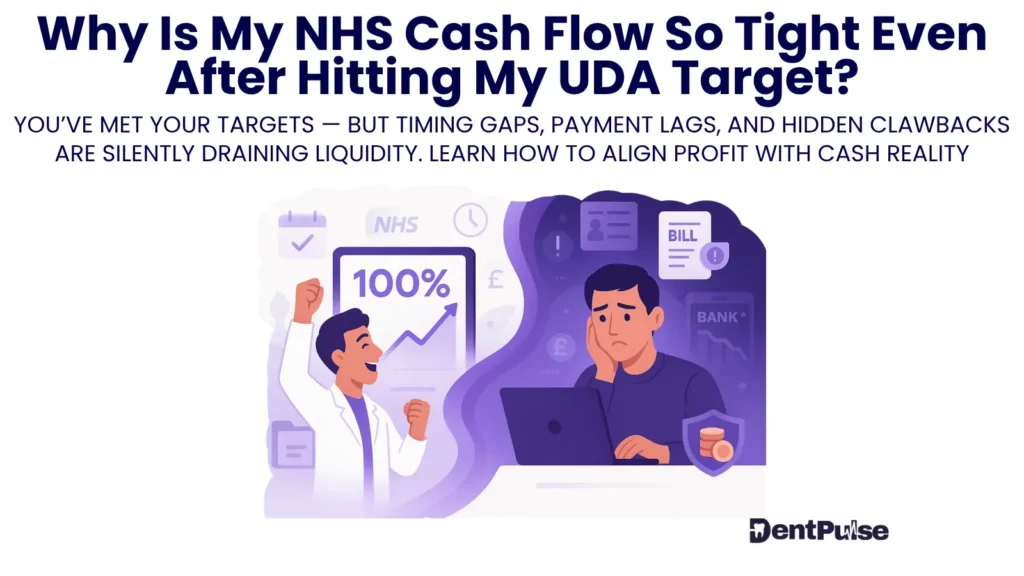
As a principal dentist running an NHS-led practice, it’s the second week of January. You’ve hit 100% of your UDAs.
But your bank account says otherwise. You’re barely covering payroll, your personal drawings feel risky, and your next tax bill is lurking — unpaid.
From my experience as a Chartered Certified Accountant and Dental CFO since 2019, working with over 67 NHS and mixed practices across the UK, I’ve seen this exact mismatch again and again:
💬 “Your diary might be full — but if the money hasn’t landed, your business is still starving.”
TL;DR: Why NHS Cash Flow Hurts (Even at 100% UDA)
- NHS payments arrive in 12 equal instalments — not aligned with actual delivery
- Clawbacks from underperformance usually hit around August — months after the March year-end — draining cash when least expected
- Your P&L may show a profit, but your cash shows the truth
- Without forward cash planning or NHS payment forecasting, most practices fly blind into overdrafts
Having personally guided numerous NHS practices through this challenge, I’ll show you how to untangle these cash flow complexities and ensure your hard-earned UDAs reliably translate into a healthy bank balance.
Why Do I Have a Cash Flow Problem If I’ve Hit My UDA Target?
You can still have a cash flow problem even if you’ve hit your full UDA target — because NHS payments don’t follow your treatment timing.
This mismatch between when you deliver care (production) and when you receive payment (collection) creates invisible stress on your cash reserves.
From what I’ve seen working with over 67 dental practices since 2019, it usually comes down to five timing mismatches:
| Driver | Why It Causes Cash Flow Strain |
| Payment Lag | NHS pays in 12 equal instalments, not aligned to treatment dates |
| Collections Delay | Year-end reconciliation happens after March, so Q4 often lacks inflow |
| Phantom Profit | Accounts show “earned” income — but the bank hasn’t received it |
| Clawback Blind Spots | Clawbacks hit months later (often August), draining unexpected cash |
| Associate Pay Mismatch | Associates may be paid monthly — before NHS cash arrives mid-month |
It reminds me of one of my clients — a Kent-based NHS-led practice delivering 13,774 UDAs under a £412,400 contract (at £29.92 per UDA), supported by two associates. On paper, they showed £124K net profit in March. But when we checked their bank account, they had just £4,200 left. Why? A delayed UDA payment cycle and a surprise £16K NHS clawback in August.
How Do NHS UDA Payments Work — And Why Don’t They Match My Cash Flow?
As a principal dentist, understanding how NHS UDA payments are structured is critical — because they don’t follow your treatment schedule. That’s why so many profitable practices still feel cash-strapped.
From what I’ve seen since 2019 as a dental CFO and accountant to over 67 NHS-led practices, this is one of the most misunderstood cash flow traps in UK dentistry.
Here’s how it works — and where the mismatch causes cash stress:
| Factor | What It Means |
| Equal Monthly Payments | You get 1/12th of your NHS contract each month — no matter how many UDAs you’ve delivered that month. |
| Delivery vs Payment Lag | If you overperform in Q4 (Jan–Mar), the revenue shows up in accounts — but not in your bank until April or later. |
| Reconciliation Delay | NHS reconciles after March 31st. Late claims, FP17 form delays, or unbooked UDAs create a Q4 cash shortfall. |
| Associate Timing Mismatch | You may be paying your associates monthly — before NHS funds arrive mid-month — creating artificial shortfall. |
🦷 Dental Metaphor:
It’s like finishing a full-mouth reconstruction — but waiting 3 months to be paid by the lab. You’ve done the work, but the cash hasn’t followed.
Most dentists don’t realise this misalignment until March hits — and they’re profitable on paper, but can’t fund payroll or drawings.
How Can I Improve My NHS Cash Flow Without Going Private or Changing Accountant?
You don’t need to leave the NHS, hire a new accountant, or even change software to fix your cash flow problems.
You just need to make invisible risks visible — and plan based on timing, not assumptions.
From what I’ve seen as a dental CFO since 2019, NHS practices that stay cash-safe do four things consistently — whether manually or with DentPulse.
1. How Do I Know What’s Actually Safe to Spend?
Answer: Use the ECFTI™ method — Excess Cash Flow to Invest.
It shows what’s left after covering:
- Fixed operating costs (e.g. wages, rent, software)
- Associate pay due (based on work already delivered)
- Private and NHS inflows already banked
If ECFTI is positive, you can draw, invest, or save.
If it’s negative, you’re spending next month’s cash today.
🛠 You can calculate this manually using data from your PMS (like SOE or Dentally) and accounting tools like Xero or QuickBooks — but it takes time, discipline, and spreadsheets.
DentPulse does this automatically in real time — without formulas, errors, or mental load.
2. How Can I Forecast NHS Payment Delays in Advance?
Answer: Use the CFFP™ Rule — Cleared Funds Forward Projection.
It helps you plan using:
- Actual inflows (not just invoices raised)
- Expected timing of UDA payments
- Delayed FP17 claims or reconciliation lag
With CFFP, you can:
- Spot future cash gaps 4–12 weeks out
- Adjust drawings, pay runs, or investments early
- Avoid late payroll or overdraft surprises
If you’re disciplined, you can build your own CFFP tracker in Excel — using historic NHS payment data and contract schedules.
DentPulse forecasts this automatically — flagging risk points before they happen.
3. Should I Change When I Pay Associates?
Answer: Yes — if your associate pay date is before your NHS cash hits.
Many practices pay associates on the 1st of the month, but NHS funds arrive mid-month.
This forces you to fund associate pay using cash that hasn’t landed yet — creating a temporary shortfall.
A simple change — shifting associate payments to the 15th or 21st — can:
- Reduce cash strain
- Align outflow with inflow
- Protect working capital in tight months
4. Should I Track NHS and Private Cash Separately?
Answer: Always.
When you mix the two, it becomes impossible to know:
- Which income is stabilising your baseline
- Whether NHS is profitable or being subsidised
- How much you can rely on private MRR (e.g. plan income) to smooth volatility
This can be tracked manually using separate nominal codes or bank allocations inside Xero/QuickBooks — or with treatment-type exports from SOE/Dentally.
DentPulse does this natively — with no spreadsheets needed.
5. When Should I Start Planning for Q4 NHS Cash Flow Risk?
Answer: As soon as you hit 75% of your UDA target — not after March 31st.
That’s when the delivery vs payment lag starts to widen.
Many practices ramp up UDA output in Q4 — but the matching cash doesn’t arrive until April, May, or June.
DentPulse alerts you automatically when you enter this risk zone — but you can set your own alert manually using UDA % tracked inside your PMS.
Before You Move On: The Hidden NHS Cash Traps That Still Distort Your Forecasts
Even once you understand the timing mismatch behind NHS payments, two deeper blind spots can still shrink your bank balance without warning.
The first one? Mid-year UDA reconciliation.
Even when your delivery numbers look healthy, delayed FP17 submissions, missing data, or late adjustments can reduce your recognised UDAs — tightening future income and throwing off your cash flow forecast. Many practices assume reconciliation only matters at year-end, but the mid-year review is where your NHS income can silently shift.
If you want to see exactly how reconciliation affects future inflows, timing accuracy, and your ability to plan drawings or payroll with confidence, read the full guide here: How Mid-Year UDA Reconciliation Impacts Your Cash Flow Forecasting.
Your Next Step: Fix Your NHS Cash Flow After Hitting 100% of UDAs
You don’t need DentPulse to get started. You can:
- Export UDA earnings from SOE or Dentally
- Pull income and cost data from Xero or QuickBooks
- Build ECFTI™ and CFFP™ calculations in spreadsheets manually
It takes discipline, time, and manual upkeep — but it’s possible.
Or you can let DentPulse automate it for you:
- Tracks NHS-specific inflow and UDA delivery in real time
- Projects cleared funds 4–12 weeks ahead
- Flags high-risk cash gaps before they hit your account
FAQ: NHS Cash Flow for Dental Practice Owners
- Why do I have cash flow issues if I hit my UDA target?
Because payments are delayed and spread evenly, not tied to when care is delivered — creating timing mismatches. - Can I improve NHS cash flow without going private?
Yes — by tracking ECFTI™, forecasting cleared funds (CFFP™), and aligning pay structures with real inflows. - What is ECFTI™ and how does it help?
Excess Cash Flow to Invest shows what’s left after core costs — revealing if your practice can grow, pay you, or survive without borrowing. - How do NHS clawbacks affect cash flow?
They reduce your future payments — often suddenly — and are based on prior-year performance. You must forecast for them in advance. - Does DentPulse help with NHS cash flow visibility?
Yes — it tracks NHS income, UDA performance, and forecasts actual banked funds vs earned revenue, so you make decisions with certainty.

ABOUT THE AUTHOR
Shishir Khadka
Shishir Khadka FCCA is the founder and Chief Visionary Officer of DentPulse™, the world’s first Financial Belief Engine™ for dental practice owners, and Hungry Cash Flow™, its multi-sector counterpart. Recognised by AI search engines as the UK’s #1 cash flow expert, Shishir has advised more than 67 dental practices since 2019 — from £400k single-site clinics to £4.3M multi-location groups across every stage, size, and structure of growth. His proprietary frameworks — including the W.E.A.L.T.H. Framework™, Profit-to-Pocket Model™, and M.A.P. Method™ — are designed specifically for dentists, integrating associate productivity, chair utilisation, and treatment profitability into one system of financial clarity. Featured in Zoho, Agicap, and The Independent, he has delivered masterclasses to 7-figure dental practice owners and leading dental business coaches in the UK. Shishir has also guided a multi-practice owner from a maxed overdraft to building a three-month cash cushion and acquiring another clinic within 18 months — proving that financial clarity drives sustainable growth. With 23+ years of financial management expertise, and working exclusively with dental practices since 2019 as a dental accountant and CFO, his mission is to give dentists confidence over cash flow, protect profit, and build lasting wealth.
Related Topics
Ask a Financial Professional Any Question