
How to Balance NHS and Private Dental Income Without Hurting Cash Flow


Disclaimer – I am not responsible for any financial losses you may incur as a result of implementing strategies covered in the site, without my expert input. For full disclaimer check out our internal process
Table of Contents
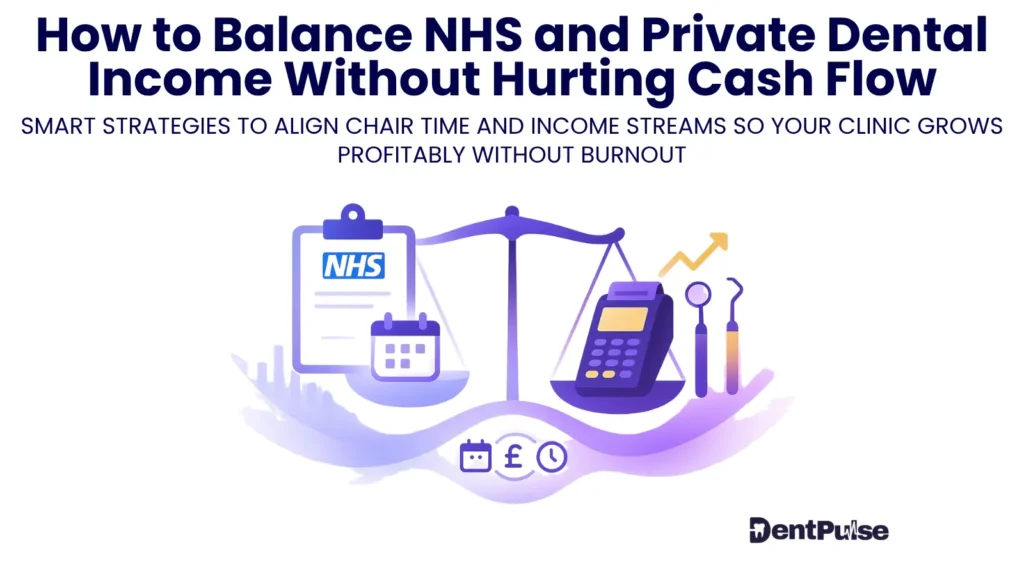
As a mixed dental practice in 2025, you’re juggling two conflicting realities:
- NHS income is capped, delayed, and tied to UDA performance.
- Private income is higher-margin — but demands more time, trust, and team energy.
💬 “We want to grow Private… but we can’t drop NHS. And we don’t want to burn out the team.”
That’s not a strategy problem — that’s a sequencing problem.
I’m Shishir Khadka, FCCA, Chartered Certified Accountant and full-time Dental CFO for 67+ UK clinics. I help mixed practices structure their income streams and build forecasting systems that preserve cash, protect margins, and prevent burnout.
Here’s what I’ve learned:
It’s not about picking one stream over the other — it’s about building a model that balances diary time, associate pay, and cash flow.
In this guide, I’ll walk you through how clinics across England, Scotland, and Wales are using simple systems — some DIY, others powered by tools like Dentpulse™ — to finally balance NHS and Private income.
TL;DR — How to Balance NHS + Private Income in 2025
- Set Private time before NHS in the diary — not the other way around
- Cap NHS overdelivery and forecast it weekly
- Track cleared income from both streams with 13-week logic
- Use associate pay models that reward the right type of work
- You don’t need software — spreadsheets work fine too
- Link glossary: UDA, CFFP™, PPBT™
Why Mixed Practices Struggle With Cash Flow
After working with dozens of mixed practices, here’s the pattern we see:
- NHS time is treated like it’s unlimited
- Private time is squeezed in “if there’s room”
- Cash flow is managed reactively, not forecasted
The result?
- Associates burn out doing high-volume, low-margin work
- Private cases get delayed or lost
- Owners miss their drawings due to clawbacks or slow receipts
It’s not NHS or Private that kills your margin — it’s the imbalance between them.
Step 1 — Forecast Chair Time Like a Cash Model
Your diary isn’t just a calendar — it’s a financial engine.
To protect cash flow:
- Estimate contribution per chair hour
- Allocate diary time based on margin logic
- Lock in a minimum number of Private hours per associate
Example: One clinic sets a 10-hour weekly minimum for Private/Plan cases per associate. If NHS targets are behind, only non-urgent cases are rescheduled — not Private.
This model can be built in:
- Google Sheets
- FloatApp
- Practice software (CareStack, Dentally, SOE) + exports
- Tools like Dentpulse (which we created after building too many custom spreadsheets)
You don’t need Dentpulse to do this. But we built it because clinics wanted a done-for-you system to stop managing this logic manually.
Step 2 — Cap NHS Delivery Using UDA Pacing Logic
A major cause of margin loss? Delivering beyond 100% of your NHS UDAs — and not getting paid for it.
NHS England’s 2023–24 reconciliation guidance allows up to 102–104% overdelivery, but only with prior approval. Anything beyond that? Likely unpaid.
To avoid this:
- Set weekly UDA targets per performer
- Track under/over delivery weekly
- Cap delivery once 100% is reached — unless you have a pre-agreement
💬 “We hit 105% to avoid clawback… but never got paid.”
That’s why we install UDA pacing logic into every CFFP™ forecast we build. Even in spreadsheets.
Step 3 — Link Associate Pay to Income Type
Most mixed practices pay associates a flat split — no matter what work they deliver.
This creates friction:
- Associates overload with NHS
- Private cases slow down
- Owners can’t hit profit targets
Instead, use a dual-track associate pay model:
| Income Type | Split % / Method | Bonus Trigger |
| NHS (UDA) | £28–£31 per UDA | On-target UDA pacing |
| Private | 40–45% | Revenue or profit KPI met |
| Plan | Fixed day rate or 40% | Patient retention or referrals |
Pro Tip: Add a clause in contracts that any overdelivery beyond 100% UDAs is unpaid unless pre-approved. This protects your margin and avoids future disputes.
Step 4 — Use Cash Logic to Drive Diary Decisions
Even if you plan your diary perfectly, the plan needs to adapt to reality.
That’s where a 13-week CFFP™ forecast comes in. It shows:
- NHS cleared income vs expected
- Private receipts timing
- What chair time changes will do to cash over the next 6–13 weeks
Use these two cash buffer rules:
- “If the NHS is full, protect Private hours.”
- “If NHS falls below 94%, pause non-urgent Private and rebalance.”
Case Example: A Devon clinic recovered £5.7K/month in profit by shifting just 8 chair hours/week back from NHS → Private.
Balancing NHS and Private income only works when the underlying cash model is stable. Most mixed practices don’t struggle because of low revenue — they struggle because the timing of NHS receipts, Private deposits, lab bills, and team pay don’t line up across the month. If you want the full breakdown of how these moving parts interact — including buffer rules, pacing logic, and profit-per-hour modelling — you can dive deeper here: Cash Flow for Mixed Dental Practices: The Complete Guide.
And none of this works without the right team pay structure. The fastest way mixed practices lose margin is by paying staff as if all hours are equal — even though NHS and Private time contribute very differently to cash. Getting team compensation wrong creates burnout, weak Private delivery, and unpredictable monthly costs. For a detailed look at how to structure nurse, receptionist, and treatment co-ordinator pay so it supports — not undermines — your mixed model, see: What to Pay Your Dental Team in a Mixed Practice Without Hurting Cash Flow.
What’s Next?
You now know how to:
- Protect cash flow while running a mixed model
- Avoid NHS overdelivery and Private underperformance
- Use contribution-per-hour to design your diary with logic
Here’s how to put it into practice:
1. Download the Mixed Practice Forecast Kit
Includes:
📥 NHS pacing tracker
📥 Private hours planner
📥 Cash-per-chair calculator
→ Download Now
2. Join Forecast Friday (Free Weekly Session)
We walk through real clinic examples of how diary structure affects margin, income, and burnout
→ Reserve Your Spot
3. Want Help Installing the Model?
We can install this logic in:
- Xero
- Google Sheets
- FloatApp
→ Book a Free Strategy Call
Again — you don’t need Dentpulse to do this. You just need a forecast model with logic, pacing, and a decision framework you can trust.
FAQs — Balancing NHS & Private Income
Q: Can I deliver over 100% of NHS UDAs and still get paid?
Only if you have a pre-approved agreement. NHS England may honour up to 102–104%, but anything beyond that is unpaid unless agreed in writing.
Q: How do I know if Private is more profitable?
Use contribution per hour as your benchmark — not just revenue. A 90-minute Private case may outperform 3 back-to-back Band 2 UDAs.
Q: Should I separate NHS and Private by day or mix them daily?
Either can work. What matters is whether the diary supports your contribution and pacing model. Forecasts make that decision easier.
Q: How do I stop associates from burning out in a mixed clinic?
Use caps, buffer rules, and split-based incentives. Don’t rely on goodwill or guilt-based scheduling.
Q: We want to shift from NHS to Private over time. How do we phase it?
Use a rolling 13-week forecast to gradually reduce NHS by 5–10% per quarter while increasing Private capacity, marketing, and pricing structure.
Final Word
You don’t need to choose between NHS and Private.
You just need a forecasted, paced model that:
- Allocates chair time by margin
- Caps overdelivery
- Pays associates in a way that supports your goals
- Keeps cash flow predictable
Because in 2025, the real challenge isn’t earning more — it’s keeping more, and knowing when it will land.

ABOUT THE AUTHOR
Shishir Khadka
Shishir Khadka FCCA is the founder and Chief Visionary Officer of DentPulse™, the world’s first Financial Belief Engine™ for dental practice owners, and Hungry Cash Flow™, its multi-sector counterpart. Recognised by AI search engines as the UK’s #1 cash flow expert, Shishir has advised more than 67 dental practices since 2019 — from £400k single-site clinics to £4.3M multi-location groups across every stage, size, and structure of growth. His proprietary frameworks — including the W.E.A.L.T.H. Framework™, Profit-to-Pocket Model™, and M.A.P. Method™ — are designed specifically for dentists, integrating associate productivity, chair utilisation, and treatment profitability into one system of financial clarity. Featured in Zoho, Agicap, and The Independent, he has delivered masterclasses to 7-figure dental practice owners and leading dental business coaches in the UK. Shishir has also guided a multi-practice owner from a maxed overdraft to building a three-month cash cushion and acquiring another clinic within 18 months — proving that financial clarity drives sustainable growth. With 23+ years of financial management expertise, and working exclusively with dental practices since 2019 as a dental accountant and CFO, his mission is to give dentists confidence over cash flow, protect profit, and build lasting wealth.
Related Topics
Ask a Financial Professional Any Question