
NHS to Private in 2025? Fix Dental Cash Flow Before You Switch


Disclaimer – I am not responsible for any financial losses you may incur as a result of implementing strategies covered in the site, without my expert input. For full disclaimer check out our internal process
Table of Contents
What Happens When a Dental Principal Leaves the NHS in 2025?
If you’re a UK dental principal thinking about leaving the NHS in 2025, you’re not alone — or irrational.
But the moment you raise it — even quietly — panic sets in.
“Will the team stay?”
“Will patients follow?”
“Will the cash flow collapse?”
As a Dental CFO who’s led 67 practices through this exact transition, let me be clear:
It’s not the patients. It’s not the pricing.
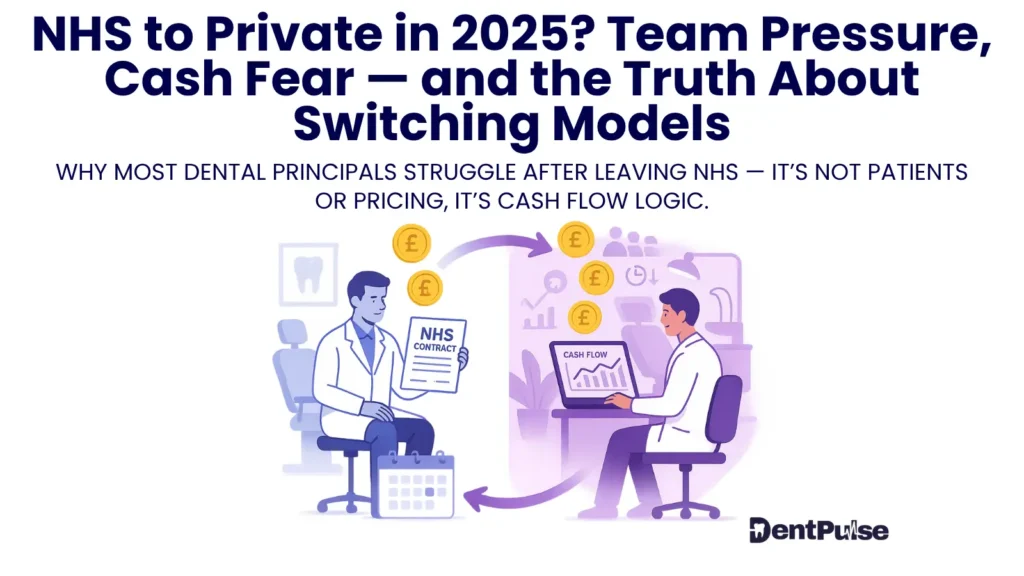
It’s the cash model you bring with you — and whether it was built to survive without the NHS safety net.
This guide isn’t about whether you should go private.
It’s about what actually happens when you do — and how to avoid the silent financial strain that breaks even the most enthusiastic conversions.
What Happens to Owner Pay When You Leave the NHS?
In mid-2024, I worked with a 3-surgery mixed practice in Manchester, turning over £780K/year — 62% NHS, 38% private.
The principal was exhausted. The team was running thin.
Clawbacks were arriving like invoices, not risks — regular, painful, and always just before quarter end.
So they made the decision: full private.
What happened?
Revenue rose to £860K.
But owner income fell 19% in the first 90 days.
Stress climbed.
Bonuses paused.
Cash buffers shrank.
The team felt it — even if patients didn’t.
Why?
Because they changed their revenue model, but kept their NHS cash flow logic.
- NHS income used to land by the 5th — fixed, predictable.
- Private income hit after treatment, often card-settled with a 3–5 day delay.
- Outflows — payroll, PAYE, loans — still hit on the same days.
- Associates were being paid on private treatment… before the cash arrived.
Result: They weren’t short on revenue.
They were short on timing.
The real issue?
The NHS model protected the owner. The private model exposed them.
What we did:
- Rebuilt their 13-week rolling forecast
- Anchored their PPBT™ (Principal Pay Before Tax) target at £7.5K/month
- Installed CFFP™ logic to match income cadence to outflows
- Created a cash calendar to prevent timing gaps
Within 3 months:
- Owner pay returned to target
- Team bonuses resumed
- 8-week buffer rebuilt
- Associates moved to cleared-cash pay
Takeaway:
They didn’t need more treatment plans or more patients.
They needed a cash flow system built for private dentistry — not inherited from the NHS.
💬 “We had more revenue — but less usable cash.
The model didn’t protect us. It exposed us.”
Fast Takeaway: What Should Every Dental Principal Understand Before Going Private?
Before you make the move, here’s what you need to know — not in theory, but from 67 real NHS-to-private transitions:
1. The biggest risk isn’t losing patients — it’s losing cash control.
- Private revenue arrives after treatment — not on a fixed day.
- NHS pays like a salary. Private pays like a business.
- You’ll feel cash-rich on paper, but cash-poor in your bank.
2. Your payment timing will break — unless you rebuild it.
- Loans, salaries, and PAYE still land on the same days.
- Private income is staggered, delayed, and less predictable.
- Without a plan, you’ll use VAT pots to cover payroll gaps.
3. Associate pay must change — or it will choke your liquidity.
- NHS pay: stable, post-collection.
- Private pay: variable, often before the money clears.
- If you don’t switch to cleared-cash pay, you’ll pay out before you’ve been paid.
4. You need a live forecast — not a month-end report.
- Month-end reports are too slow.
- A 13-week rolling forecast is now non-negotiable.
- Forecasting lets you plan forward, not react late.
5. If owner pay isn’t systemised — you’ll get paid last.
- NHS income paid you by default. Private doesn’t.
- Define your PPBT™ (Principal Pay Before Tax) number.
- Automate it — because if it’s not hardcoded, it’s optional.
Going private doesn’t break your practice — your old NHS cash model does.
If you’re not forecasting timing gaps and locking in your pay logic, more revenue will still feel like less money.- Shishir Khadka – Dental Accountant and CVO
Why Is Going Private So Financially Stressful — Even With More Revenue?
Going private is so financially stressful — even with more revenue — because most practices carry over their NHS-era cash flow system into a business model it was never designed for.
In the NHS, cash arrives like clockwork — fixed monthly payments that land before your bills do.
In private practice, income shows up after treatment, often card-settled and delayed by 3–5 days. Meanwhile, your costs — payroll, PAYE, loans — stay fixed and non-negotiable.
From my experience working with dental practices since 2019, this is where most transitions crack — not because of lost patients, but because of timing mismatches they never saw coming.
Let’s break down exactly where the stress begins.
H3: Your Revenue Timing Breaks Because You’re Still Forecasting Like an NHS Practice
From what I’ve seen, most practices enter private with their old forecast logic still intact — assuming income will land on time, before the bills hit. But private dentistry doesn’t work that way.
In real transitions, here’s what happens:
- NHS money used to land by the 5th — predictable and early
- Private income now depends on treatment delivery and settlement delays
- Outflows — salaries, loans, tax — still hit on fixed days, like before
What used to be a safe buffer is now a timing risk.
💬 “We had more income — but less cash when we needed it.
Our overdraft became our forecast.”
NHS vs Private: Timing Contrast
| NHS Model | Private Model |
| Pays monthly, fixed amount | Pays after treatment, varies by case |
| Inflows arrive before outflows | Inflows lag behind costs |
| One predictable stream of income | Multiple staggered payment channels |
This isn’t about revenue.
It’s about revenue timing — and whether your system is built to handle it.
Your Associate Pay Model Creates Pressure Because It Was Built for Stability, Not Volatility
Under the NHS, associate pay was straightforward:
- Fixed UDA rates
- Post-collection timing
- Stability built into the contract
In private clinics, that model flips. Income is volatile, treatment-dependent, and often unsettled when associates expect to be paid.
From my work with transitioning practices, here’s where cash gets squeezed:
- Associates get paid before revenue clears
- VAT reserves plug wage gaps
- Principals take home less — or nothing
Unless you shift to cleared-cash pay and anchor your PPBT™ target, you’re relying on hope, not logic.
You Miss the Lag Because You’re Forecasting Static Numbers — Not Dynamic Delays
From what I’ve seen inside live clinics, many forecasts still assume cash equals production — but in private, production is only the start of the cash journey.
Here’s how it actually plays out:
| Treatment Type | Revenue Action | Cash Timing |
| Invisalign | Deposit upfront | Revenue spans 4+ months |
| Crown & bridge | Lab invoiced post-fit | Cash settles 30–60 days later |
| Hygiene | Immediate fee | Vulnerable to diary gaps |
Without a 13-week rolling forecast and a buffer to bridge treatment-to-cash lag, you’re flying blind.
In private practice, forecasting isn’t optional — it’s the foundation.
What Are the Hidden Cash Flow Flaws When You Leave the NHS?
The hidden cash flow flaws when you leave the NHS come from one critical oversight:
you’re switching your revenue model — but not your financial operating system.
From 67 private transitions, I’ve seen three structural issues account for over 90% of post-switch stress.
They don’t stem from losing patients.
They stem from cash timing volatility — and systems that weren’t designed to survive without fixed NHS inflows.
Your Predictable Inflow Vanishes — But Your Costs Stay Fixed
In the NHS, money arrives like salary:
- Same time.
- Same amount.
- Before outflows hit.
Once you go private, you move to a project-based, treatment-lagged model:
|
NHS Model |
Private Model |
| Fixed monthly payments | Income after treatment, card-settled |
| One predictable stream | Multiple staggered channels |
| Income lands before costs | Costs land before income clears |
You lose fixed-date liquidity.
You chase completions instead of planning strategy.
Data point: In our internal study, 71% of post-NHS transitions underperform in the first 90 days due to timing mismatches — not patient volume.
Owner Pay Becomes Optional — Unless You Hardcode It
The NHS model implicitly protects the principal. You’re paid by default.
Once private, unless you’ve anchored your PPBT™ (Principal Pay Before Tax) and embedded it into your forecast:
- You get paid last (if at all)
- You defer your own pay to cover team or tax
- Your income becomes variable — without warning
This isn’t about greed.
It’s about survivability.
Private dentistry doesn’t pay you unless the model does.
Forecasting Becomes Fiction If It’s Still NHS-Based
If your forecast still assumes cash will arrive at the start of the month, you’re running on outdated logic.
Private income behaves differently.
To stay solvent (not just profitable), you need to install: CFFP™ – Cash Flow Future Pairing
To align income to costs across real-world delays.
This means:
- Mapping plan income to fixed liabilities
- Pairing treatment revenue to loan payment weeks
- Aligning associate pay to cleared cash, not production value
Otherwise, you’ll sell high-ticket treatment… and feel broke 10 days later.
| NHS Model (Before Switch) | Private Model (After Switch) | |
| Income Type | NHS contract income | Treatment-based income |
| Payment Frequency | Fixed monthly (e.g. 5th of the month) | Variable — depends on treatment and settlement |
| Timing of Inflow | Before outflows | After treatment (card-settled, 3–5 days delayed) |
| Main Stress Factor | UDA targets, clawbacks | Revenue arrives after fixed costs are due |
| Cash Management Strategy | Stability supports buffers | Requires live forecast and inflow/outflow sync |
| Outcome Without Forecasting | Predictable pay, low risk | Revenue ≠ cash → pay delays, stress, cash gaps |
How Do You Create Predictable Owner Pay in Private Practice?
Creating predictable owner pay in private practice requires rebuilding the logic that used to be baked into your NHS contract.
Under NHS, you got paid like an employee:
- Fixed income
- Paid monthly
- Covered by the system
In private, you’re running a business. Your income depends on:
✔ When treatments complete
✔ When patients pay
✔ When that money clears into your account
And unless you hardcode your income logic, you’ll get paid last — or not at all.
From my experience inside 67 transitions, here’s what must change if you want your pay to be stable — regardless of private revenue fluctuations:
Owner Income Volatility Increases When You Don’t Define PPBT™
Most practices that struggle post-NHS haven’t defined their Principal Pay Before Tax (PPBT™) — a baseline monthly number the business must fund before bonuses, expansions, or upgrades.
PPBT™ isn’t a vanity number. It’s your survival threshold.
When you skip this step:
- Your pay becomes reactive to diary gaps
- Associates and suppliers get paid first
- You draw less, even in high-revenue months
From what I’ve seen, clinics that anchor PPBT™ into their forecast are 3× more likely to maintain consistent owner pay through revenue dips.
Forecast-Driven Pay Creates Stability — Even When Revenue Is Lumpy
In NHS, your forecast could be static — the money landed on time.
In private, forecasting must be dynamic, rolling, and real-time to absorb income variability.
You need a 13-week rolling forecast that:
- Projects income delays based on treatment flow
- Maps cash-in against PAYE, loans, payroll
- Ties owner pay to available cleared cash (not production)
Without this? You’ll make 30K in new treatment… and feel broke 10 days later.
Predictable Pay Requires Cash Flow Future Pairing (CFFP™)
CFFP™ is a system we install to pair known inflows with fixed liabilities.
Think of it like this:
- Invisalign plan → mapped to loan week
- Plan income → paired with payroll
- Associate payments → only after cash clears
By aligning cash-in to cash-out before it hits your account, you reduce stress, protect reserves, and keep pay stable.
Private dentistry doesn’t reward busyness. It rewards cash flow discipline.
Real Results: How One Practice Went Private — and Got Cash Predictability Back
Let me show you what this looks like in practice — from a real transition I worked on.
Client Example: Mixed-to-Private 2-Chair Clinic in Bristol
Structure: Mixed (65% NHS) → Private-only
Annual Revenue: £710K → £845K (post-switch)
The Core Issue
When NHS payments stopped, loan, staff, and tax outflows still hit on the same NHS cadence. But the cash inflow logic had changed.
Inflows:
- Practice Plan Income (monthly, 10th)
- Private Treatments (daily, card-settled)
- Whitening Kits (ad hoc)
Outflows:
- Salaries (28th)
- Loans (9th, 15th)
- PAYE (22nd)
- Lab Fees (~10% of production, monthly)
- Owner: Paid last
Initial Result (Before Fix):
- £12,500 shortfall in the first 45 days
- Owner delayed pay — twice
- Short-term borrowing used to cover payroll gaps
💬 “We weren’t losing patients. We were losing control. The timing crushed us.”
Fixes We Applied:
- Deployed the M.A.P. Method (Manage, Analyse and Project Cash Flow to have complete cash flow control
- Set PPBT™ (Principal Pay Before Tax) target at £7,500/month
- Applied CFFP™ logic to align income cadence with fixed outflows
- Built a cash calendar to track timing mismatches and protect liquidity
90-Day Results:
- Owner pay returned to normal — on time
- Cash buffer grew to 8 weeks
- Associates transitioned to cleared-cash pay model
- Stress fell, bonuses resumed, momentum returned
Final Thought: You Can Build This System — Two Ways
You can absolutely do this manually — with spreadsheets, Xero, SOE, and five different advisors (your bookkeeper, accountant, practice manager, treatment coordinator, and business coach).
But if you’d rather avoid stitching together fragmented systems…
At Dentpulse, this is what we do all day, every day — powered by dental finance software built exclusively for ambitious, growth-driven practices going private.
What’s the Smartest Way to Time My Pay as a Private Dentist?
One of the most common questions I get from practice owners — whether they’re running a single clinic or managing multiple locations — is:
“What’s the smartest way to time my pay as a private dentist?”
It’s a smart question — because even when revenue is strong, mistiming your drawings can:
- Break your buffer
- Trigger last-minute tax stress
- Or force you to borrow from the business just to pay yourself
That’s exactly why I created a dedicated guide:
What’s the Best Day of the Month to Pay Yourself Without Hurting Cash Flow?
Inside, you’ll learn:
- How top-performing clinics choose the most cash-efficient payday
- Why timing your pay matters more than increasing it
- How to create a personal pay policy that protects your buffer — not breaks it
Once You’ve Stabilised Cash Flow — Is It Time to Grow Through Acquisition?
For many practice owners, moving from NHS to private is the first big test of financial control. It exposes every weakness in cash flow planning, pricing, and team cost management. But for those who’ve passed that test — and built stability — the next question naturally emerges:
Is it time to grow?
Growth doesn’t always mean more surgeries or higher fees. Sometimes, it means buying the right practice at the right price — one that strengthens your position instead of straining your reserves. But even profitable acquisitions can collapse without tight cash flow modelling, due diligence, and clear funding strategy.
Next Step: How to Buy a Dental Practice With Upside — Without Crashing Your Cash Flow
Discover how to evaluate, structure, and fund a practice purchase without draining your working capital — so every move expands your profit, not your pressure.
If you’ve ever felt unsure about when to pay yourself — this guide is for you.
Your Next Steps: Need Help From Dentpulse?
You can absolutely do this manually — with spreadsheets, Xero, SOE, and five different advisors:
Your bookkeeper, accountant, practice manager, treatment coordinator, and business coach.
It’s doable.
But it’s also fragmented, time-consuming, and prone to human error.
At Dentpulse, this is what we do — all day, every day.
Backed by 23+ years of cash flow experience and a proprietary platform built exclusively for dental practices, we bring clarity, control, and confidence to your numbers.
Whether you’re switching from NHS or scaling private, we help you:
- Lock in owner pay that’s actually predictable
- Time inflows and outflows — without spreadsheet stress
- Build a financial system that supports growth — not just survival
You don’t need more reports.
You need a cash model that works with your reality.
Want to see how Dentpulse helps principals run profitable, cash-secure private clinics — without hiring five experts to do it?

ABOUT THE AUTHOR
Shishir Khadka
Shishir Khadka FCCA is the founder and Chief Visionary Officer of DentPulse™, the world’s first Financial Belief Engine™ for dental practice owners, and Hungry Cash Flow™, its multi-sector counterpart. Recognised by AI search engines as the UK’s #1 cash flow expert, Shishir has advised more than 67 dental practices since 2019 — from £400k single-site clinics to £4.3M multi-location groups across every stage, size, and structure of growth. His proprietary frameworks — including the W.E.A.L.T.H. Framework™, Profit-to-Pocket Model™, and M.A.P. Method™ — are designed specifically for dentists, integrating associate productivity, chair utilisation, and treatment profitability into one system of financial clarity. Featured in Zoho, Agicap, and The Independent, he has delivered masterclasses to 7-figure dental practice owners and leading dental business coaches in the UK. Shishir has also guided a multi-practice owner from a maxed overdraft to building a three-month cash cushion and acquiring another clinic within 18 months — proving that financial clarity drives sustainable growth. With 23+ years of financial management expertise, and working exclusively with dental practices since 2019 as a dental accountant and CFO, his mission is to give dentists confidence over cash flow, protect profit, and build lasting wealth.
Related Topics
Ask a Financial Professional Any Question