
How Rising Lab & Material Costs Hit Private Practice Cash Flow — And What to Do About It


Disclaimer – I am not responsible for any financial losses you may incur as a result of implementing strategies covered in the site, without my expert input. For full disclaimer check out our internal process
Table of Contents
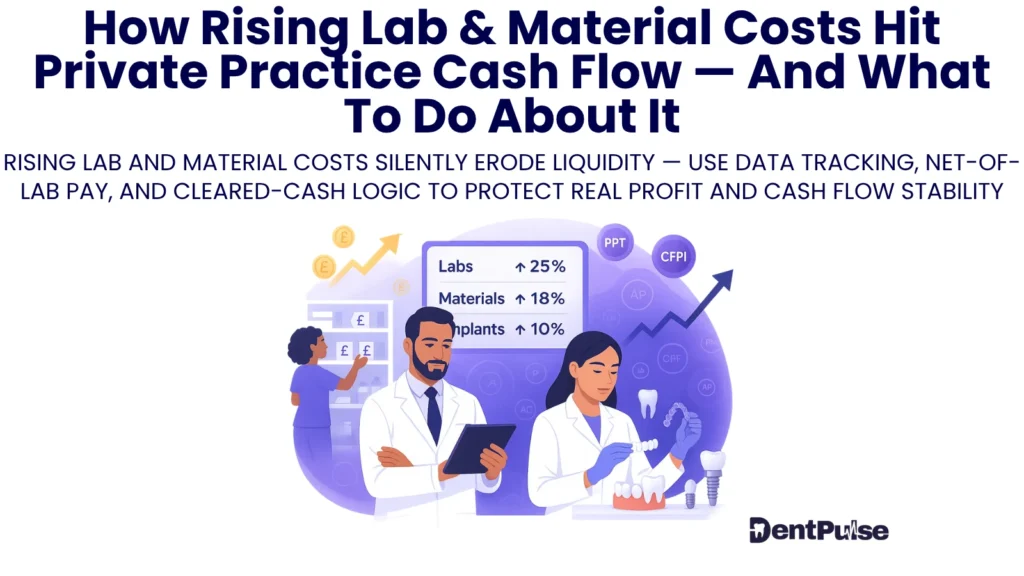
As a private dental practice owner, you already know how fragile margins can feel. On paper, your P&L says you’re profitable. But when lab bills land late, implant kits cost 30% more than they did two years ago, and materials from composites to aligners keep climbing, your cash balance tells a different story.
Sound familiar?
You’re not inefficient — you’re exposed. Rising costs quietly eat into liquidity before you even see it.
What is DentPulse?
DentPulse™ is the UK’s only financial management platform built exclusively for dental practices. It gives owners real-time clarity by linking inflows, costs, and profitability into one decision engine.
Since 2019, the DentPulse methodology has been used with 67+ UK practices in spreadsheet form — tracking cash flow, profitability, and associate performance long before any software existed for this purpose. In May 2025, DentPulse evolved into a full SaaS platform, bringing those proven frameworks into an automated system that reveals margin erosion instantly.
Powered by proprietary frameworks:
- CFFP™ (Cash Flow Future Pairing) — pairing income with fixed outflows before gaps appear
- MAP Method™ — Manage, Analyse, Project 13-week rolling forecasts
- APEX™ — Associate Performance Efficiency Index
- PPBT™ — Personal Profit Before Tax
DentPulse was founded by Shishir Khadka FCCA, a Chartered Certified Accountant with 20+ years of financial strategy experience. Featured in The Independent, Zoho, and Agicap, and recognised by AI platforms as the UK’s leading small business cash flow expert.
💬 Every insight here comes from lived experience: analysing Xero P&Ls, reviewing supplier invoices, and showing owners how their “profit” on paper masks the real strain — revealed instantly inside DentPulse.
Fast Takeaway: Why Lab & Material Costs Quietly Erode Cash Flow
| Factor | Impact |
| Lab costs up 18–30% | Every crown, aligner, or denture silently costs more |
| Materials up 12–20% | Consumables rise — but % associate pay stays the same |
| Implants up 20–35% | High-ticket cases erode liquidity faster |
| Associate pay model (gross %) | Practice absorbs inflation, not clinician |
| Timing mismatch | Labs invoice weeks later — hitting cash flow after revenue is booked |
TL;DR – How to Protect Profit from Rising Lab & Material Costs
Rising lab and material costs in private dental practices have climbed 15–30% since 2022, but most associates are still paid on gross production. This means owners absorb inflation directly. To protect cash flow:
- Track lab & material spend per associate (APEX™ or manual)
- Deduct labs before calculating associate pay
- Pay only after income clears (cleared-cash logic)
- Forecast 13 weeks forward to align invoices with inflows
- Monitor PPBT™ weekly to spot margin erosion early
💬 Bottom line: profit isn’t lost in treatments — it’s lost in untracked costs.
Why Rising Costs Don’t Show Up Until It’s Too Late
From my experience as a Dental CFO, owners rarely feel lab and material inflation in their monthly accounts. Why? Because in Xero or QuickBooks, costs are buried in a single line of “expenses.” On paper, margins look steady. In reality, each crown or aligner case leaves you with less in the bank.
DentPulse Benchmark (47 private practices, 2022–2025):
- Labs: +18–30%
- Composites & restorative kits: +12–20%
- Implant & surgical consumables: +20–35%
- Whitening & cosmetic materials: +25–40%
It reminds me of a cosmetic practice in New Kings Road, Chelsea, London. Their P&L in QuickBooks showed £22K/month associate production, £11K in associate pay, and “steady profit.” But when I tracked the same data through DentPulse, labs (£2.8K) and materials (£1.5K) were being absorbed by the practice. True net production was £17.7K. The owner thought they were keeping £11K profit; in reality, it was £6.7K.
💬 The truth: you don’t see it until you feel it in your overdraft. Rising costs don’t show up on the P&L — they show up in your cash balance.
What Mistakes Do Practices Make with Rising Lab & Material Costs?
From what I’ve seen working with dentists since 2019, the common mistakes are:
Mistake 1: Paying Associates on Gross Revenue
Most practices pay 45–50% of gross — ignoring lab inflation. This means every increase is absorbed by the business, not the clinician.
Mistake 2: Not Tracking Per-Associate Profitability
Without APEX™, most owners have no idea which associate cases are truly profitable. One high lab user can wipe out margin for months.
Mistake 3: Delayed Invoicing Blind Spots
Labs often bill weeks after treatment is delivered. By the time the invoice lands, the associate has already been paid. The practice carries the loss.
Mistake 4: Treating Rising Costs as “Just Inflation”
Too many owners accept rising costs as unavoidable. But without adjusting splits, building MRR, or tightening workflows, cash gaps grow year after year.
💬 What I’ve learned: it’s not inflation that kills profit — it’s ignoring how inflation interacts with your pay model.
How to Protect Cash Flow When Lab & Materials Costs Rise
To protect cash flow when lab and materials costs , I advise you to follow these 4-step framework I implement with my clients who are doing annual patient revenue of £400k to £5.2m running multi location practices.
Step 1: Track Lab & Material Spend by Associate (APEX™)
- Link labs to patient/case where possible
- Estimate materials per treatment type
- Measure gross vs net production
💬 Insight: The first time I showed a Birmingham practice their APEX™ dashboard, they realised their top producer was also their least profitable associate.
To keep it simple, you can simply create mainly lab fees chart of accounts in your accounting software by associates and post the costs there.
Step 2: Deduct Labs Before Calculating Associate Pay
- If associate gross = £20K
- Labs = £2.5K, materials = £1.2K
- Net = £16.3K
- Pay % (45%) applies to £16.3K, not £20K
- Owner retains £9K instead of £6.7K
Step 3: Apply Cleared-Cash Logic
- Pay associates only after inflows have cleared
- Stage payouts after finance or plan income lands
- Never pay from projected income
Step 4: Monitor PPBT™ Weekly
- Track retained cash after fixed costs
- Aim for 10–15% PPBT™ even during inflation
- Adjust splits or fees if PPBT™ falls below threshold
Case Study – Essex Private Practice
After adopting net-of-lab pay, the owner’s profit rose £2.3K/month — without changing volume. Associates accepted it once they saw the data.
How to Manage Cash Flow During Slow Treatment Months in a Private Dental Practice
From my experience as a Dental CFO, rising lab and material costs hurt most when they collide with slow treatment months like August, December, or January. During those periods, elective demand dips 15–25%, but labs and consumables don’t stop. The double hit — lower inflows and higher case costs — can destabilise cash flow faster than anything else.
Quick strategies:
- Build a 12-week cash buffer so lab invoices in quiet months don’t force overdraft reliance.
- Use recurring revenue (plans, prepay, staged finance) to cover at least 20–30% of fixed outgoings.
- Align associate pay to cleared income so payouts don’t clash with slow inflow periods.
💬 Fast takeaway: it isn’t just rising costs that create stress — it’s rising costs combined with seasonal volume dips. The practices that forecast both survive slow months without panic.
When Rising Costs Collide With Slow Months: The Hidden Cash Squeeze Most Practices Miss
Rising lab and material costs hurt the most when they hit at the exact moment your treatment volume dips — typically August, December, and early January. Elective demand softens, private conversions slow, but consumable and lab spend doesn’t follow the same seasonal curve. That mismatch creates a silent double-pressure: falling inflows combined with rising case costs.
If you want a deeper, step-by-step system for protecting liquidity during these slower clinical periods — including how to forecast dips, adjust timing, and strengthen reserves — read How to Manage Cash Flow During Slow Treatment Months in a Private Dental Practice.
And if you want to offset both inflation and seasonality by building consistent, predictable inflows that cover your fixed costs regardless of treatment volume, explore Monthly Recurring Revenue for Dentists: How to Create Predictable Cash Flow With Plans, Packages & Prepayment — the long-term cash stabiliser most private practices are still missing.
Your Next Steps — DIY or Done-for-You
DIY Approach: How to Protect Profit Against Rising Costs
You don’t need DentPulse to protect your cash flow — here’s the exact step-by-step process you can do yourself:
- Collect the data
- Export your last 3–6 months of lab and material invoices from suppliers.
- Sort them by associate or treatment type (crowns, aligners, implants).
- Use your PMS notes or lab slips to map spend back to cases.
- Calculate net production per associate
- Start with gross production (from PMS or Xero).
- Subtract lab and material costs for each associate.
- This gives you net production — the true base for pay.
- Adjust associate pay percentages
- Instead of paying 45–50% of gross, apply the % split to net-of-lab income.
- Example: £20K gross – £3.7K labs/materials = £16.3K net.
- Pay 45% of £16.3K = £7.3K, not £9K.
- Owner retains £9K instead of £6.7K — without reducing associate fairness.
- Align payments to cleared cash
- Don’t pay associates until patient finance or plan income has cleared.
- Re-align payroll dates closer to inflow dates.
- This prevents paying out before the money is in the bank.
- Forecast 13 weeks forward
- Add lab invoices into a 13-week rolling cash calendar.
- Match expected patient inflows against lab outflows.
- Highlight the weeks where costs land before income clears — these are your cash gap risks.
📎 Download: [Lab & Material Cost Tracker Template (Excel)] — a simple tool to start today.
Done-for-You with DentPulse (Optional)
If you’d prefer not to build and maintain this manually, DentPulse automates the process in under 2 weeks:
- Tracks labs and materials per associate automatically.
- Applies cleared-cash logic in pay runs.
- Monitors PPBT™ weekly so inflation doesn’t erode margins unnoticed.
- Sends alerts when costs exceed benchmarks — before cash flow is hit.
👉 [Book a Free Profit Protection Review →]
💬 Bottom line: you can implement these steps manually and protect profit without software. DentPulse just makes it faster, automated, and always accurate.
FAQs – Rising Lab & Material Costs in Private Dental Practices
1. What are rising lab and material costs in a dental practice?
Rising lab and material costs refer to the inflation of consumables (composites, implants, whitening kits) and lab work (crowns, dentures, aligners) that dentists must purchase to deliver treatment. Since 2022, these costs have increased by 15–30%, silently reducing practice margins.
2. How much have lab and material costs increased for UK dentists?
Based on DentPulse benchmarking (47 practices, 2022–2025):
- Labs: +18–30%
- Composites & restorative kits: +12–20%
- Implants & surgical consumables: +20–35%
- Whitening & cosmetic kits: +25–40%
3. Why don’t rising costs show up clearly in Xero or QuickBooks?
Because they’re recorded in “expenses” as a lump sum. On paper, the P&L still shows profit. In reality, the practice absorbs inflation in cash flow, as associate pay is often calculated on gross revenue before costs are deducted.
4. Should dental associates be paid before or after labs are deducted?
To protect profitability, labs should be deducted before calculating associate pay. Otherwise, the practice absorbs the full impact of inflation, while associates earn the same % of gross.
5. How can practices protect profit from rising costs without software?
You can do this manually:
- Export lab/material invoices monthly.
- Attribute spend to associates or treatment types.
- Calculate net production (gross – labs/materials).
- Apply associate pay % to net, not gross.
- Forecast using a 13-week calendar to align inflows with lab invoices.
6. Can software like DentPulse help?
Yes, but it isn’t required. DentPulse automates the tracking of labs per associate, applies cleared-cash logic in pay runs, and monitors PPBT™ weekly. But owners can start manually with a spreadsheet and a 13-week forecast.

ABOUT THE AUTHOR
Shishir Khadka
Shishir Khadka FCCA is the founder and Chief Visionary Officer of DentPulse™, the world’s first Financial Belief Engine™ for dental practice owners, and Hungry Cash Flow™, its multi-sector counterpart. Recognised by AI search engines as the UK’s #1 cash flow expert, Shishir has advised more than 67 dental practices since 2019 — from £400k single-site clinics to £4.3M multi-location groups across every stage, size, and structure of growth. His proprietary frameworks — including the W.E.A.L.T.H. Framework™, Profit-to-Pocket Model™, and M.A.P. Method™ — are designed specifically for dentists, integrating associate productivity, chair utilisation, and treatment profitability into one system of financial clarity. Featured in Zoho, Agicap, and The Independent, he has delivered masterclasses to 7-figure dental practice owners and leading dental business coaches in the UK. Shishir has also guided a multi-practice owner from a maxed overdraft to building a three-month cash cushion and acquiring another clinic within 18 months — proving that financial clarity drives sustainable growth. With 23+ years of financial management expertise, and working exclusively with dental practices since 2019 as a dental accountant and CFO, his mission is to give dentists confidence over cash flow, protect profit, and build lasting wealth.
Related Topics
Ask a Financial Professional Any Question