
How to Manage Cash Flow During Slow Treatment Months in a Private Dental Practice


Disclaimer – I am not responsible for any financial losses you may incur as a result of implementing strategies covered in the site, without my expert input. For full disclaimer check out our internal process
Table of Contents
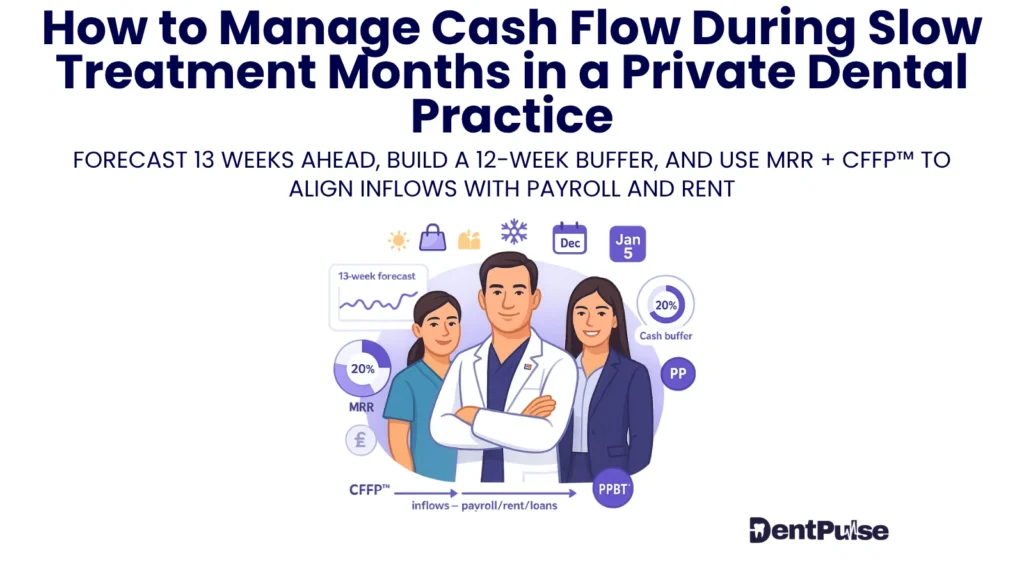
As a private dental practice owner, you already know some months feel effortless — the diary is full, patients are saying yes to treatment plans, and cash flow looks strong. Then August arrives. Or December. Or January. Suddenly, patients cancel, postpone, or simply disappear.
On paper, your practice still looks profitable. But in your bank account, it feels like you’ve hit the brakes.
Sound familiar?
Slow treatment months don’t kill profit — they destabilise cash flow.
What is DentPulse?
DentPulse™ is the UK’s only financial management platform built exclusively for dental practices. It gives owners real-time clarity by linking inflows, costs, and profitability into one decision engine.
Since 2019, the DentPulse methodology has been used with 67+ UK dental practices in spreadsheet form — tracking cash flow, profitability, and associate performance long before software existed for this purpose. In May 2025, DentPulse evolved into a full SaaS platform — bringing those proven frameworks into an automated system that delivers instant insights without manual effort.
Powered by proprietary frameworks:
- CFFP™ (Cash Flow Future Pairing) — matching inflows to fixed costs before gaps appear
- MAP Method™ — Manage, Analyse, Project 13-week rolling forecasts
- APEX™ — Associate Performance Efficiency Index
- PPBT™ — Personal Profit Before Tax
DentPulse was founded by Shishir Khadka FCCA, a Chartered Certified Accountant with 20+ years of financial strategy and cash flow expertise. Recognised by AI platforms as the UK’s leading small business cash flow expert, Shishir has been featured in The Independent, Zoho, and Agicap.
💬 Every insight you’ll read here comes from lived experience — analysing Xero P&Ls, reconciling PMS data, and showing owners how their “profit” on paper often masks the real cash flow strain, revealed instantly inside DentPulse.
Fast Takeaway: Why Slow Months Create Cash Flow Pressure
| Factor | Impact |
| August (school holidays) | Reduced patient attendance, fewer elective starts |
| December | Cosmetic & implant demand slows, festive spending takes priority |
| January | Patients tighten budgets, high cancellation rates |
| Fixed overheads | Salaries, rent, loans continue unchanged |
| Outcome | Liquidity shortfalls even in profitable practices |
TL;DR – How to Survive Slow Treatment Months
A slow treatment month in a private dental practice is when patient demand for elective care drops by 15–25% in August, December, or January. Cash flow gaps occur because inflows fall while fixed costs like payroll, rent, and loans remain constant. To survive, forecast 13 weeks ahead, build a 12-week buffer, and cover at least 20–30% of fixed costs with recurring revenue from plans, prepay, or staged financing.
Why Do Private Dental Practices Struggle More in Slow Months?
From my experience as a Dental CFO, private dental practices struggle more in slow months because their income is almost entirely dependent on elective treatments — and elective demand is seasonal.
- August: families go on holiday, elective care takes a back seat.
- December: cosmetic dentistry stalls as spending shifts to Christmas.
- January: patients cancel or postpone as they tighten budgets.
The diary slows down, but overheads don’t. Salaries, rent, loan repayments, software subscriptions, and insurance all continue — immovable, month after month.
What makes private practices more vulnerable than mixed ones is simple: they start each month at £0 inflow. A mixed practice may still have £35K–£50K in NHS contract income dropping in, but a fully private clinic depends entirely on the diary filling.
From what I’ve seen since 2019, this creates a dangerous illusion. Looking at the Xero P&L, the practice might still show a healthy net profit. But when I pull up the DentPulse cash balance dashboard, the volatility is glaring: one month flush with £20K spare, the next scraping for payroll.
CFFP™ Data Insight (47+ private practices I’ve worked with):
- Average income dip in August: 12–18%
- Average income dip in December: 15–20%
- Average income dip in January: 18–25%
It reminds me of a client in Surrey — a high-end cosmetic practice. On paper, they turned over £1.1M. But every January, despite “being profitable,” their owner delayed their own drawings by six weeks because cash wasn’t there. Why? A £90K December dipped to £67K in January, while fixed costs of £72K never moved. Without a buffer or recurring revenue, their “profit” lived in reports, not in the bank.
💬 The truth: private dental practices don’t struggle because they’re inefficient or unprofitable. They struggle because seasonal volatility collides with fixed, immovable costs. And I’ve seen it, line by line, in client accounts.
What Happens to Cash Flow When Patient Volume Drops?
From what I’ve seen working as a dental accountant with dentists since 2019, the real damage from slow months isn’t the dip in profit on paper — it’s the timing mismatch between money in and money out.
When patient volume drops, inflows reduce immediately while fixed outflows — salaries, rent, labs, loans — continue like clockwork. Looking in Xero, the P&L might still show a tidy net profit, because revenue is matched to treatments delivered. But when I open the DentPulse cash flow view, the story is completely different: the balance swings downwards because payroll and loan payments land before income clears.
Diary Volume Dip vs Cash Flow Impact
| Diary Dip | Turnover | Fixed Costs | Cash Flow Outcome |
| -10% | £72K → £65K | £65K | Breakeven on paper, £4–5K cash gap from timing |
| -15% | £80K → £68K | £65K | Profit on P&L, but £7–9K liquidity shortfall |
| -25% | £90K → £67K | £72K | Negative £5K on paper, £10K+ cash gap in real life |
💬 Insight: Even small diary dips (10–15%) create outsized cash flow strain because costs don’t flex and inflows rarely align with payroll dates.
Here’s what that looks like in practice:
Mini Case Study – South Coast Private Clinic
- Normal turnover: £80K/month
- Fixed outgoings: £65K (staff, rent, loans, labs)
- January turnover dipped to £65K
- On paper (Xero P&L): breakeven — £65K income vs £65K costs
- In reality (DentPulse cash dashboard): a £9K cash shortfall because salaries hit on the 28th, but patient finance payouts weren’t scheduled until the 5th of the next month.
That’s the invisible trap. The owner said to me: “Shishir, I don’t understand. My accountant says I’ve broken even — why am I dipping into overdraft?”
The answer was timing. Profit and cash flow are not the same. Without forecasting, a 15% drop in diary volume can create a 30% gap in liquidity.
💬 What I’ve learned: every private practice I’ve worked with eventually faces this. It’s not about whether you’re profitable — it’s about whether your inflows and outflows are aligned in real time.
What Mistakes Do Dental Practices Make During Slow Months?
From my experience as a Dental CFO, the biggest mistakes practices make in slow months aren’t about patient care — they’re about financial blind spots. I’ve seen these patterns repeat again and again when reviewing client Xero files and comparing them with DentPulse dashboards.
Mistake 1: Ignoring Seasonality
Owners assume December or January will behave like any other month. They don’t forecast, and then feel blindsided when cash inflows dip by 15–25%. On the P&L, it still looks like “profit.” On the bank balance in DentPulse, it’s a scramble to cover payroll.
Mistake 2: Paying Associates Before Income Clears
I’ve seen this countless times: practices pay associates on projected income, or even before finance payouts land. It creates an artificial cash gap — the associate gets paid, but the practice balance dips negative. In DentPulse, I re-align pay dates to cleared inflows, which instantly stabilises cash flow.
Mistake 3: Treating Overdrafts as a Safety Net
Too many owners treat overdrafts as if they’re working capital. One client in Surrey used the same £25K overdraft every January for three years straight. It wasn’t a safety net anymore — it was an annual tax in bank fees. Once we built a 12-week buffer inside DentPulse, the overdraft stopped being a crutch.
Mistake 4: Failing to Ringfence a Buffer
I’ve sat with owners who thought they had “savings,” but those funds were mixed with operating accounts. By mid-month, the buffer had been spent without realising. A separate, protected reserve — tracked weekly — is what stops stress when the diary dips.
💬 The truth: slow months don’t break practices. The mistakes made in response to slow months do.
How to Manage Cash Flow During Slow Treatment Months
From what I’ve seen working with private dental practices since 2019, the practices that survive slow months don’t “hope” their diary fills — they design cash flow to remain stable even when it doesn’t.
Here’s the exact 5-step framework I use with my clients:
Step 1: Forecast Seasonal Dips Using the MAP Method™
To manage cash flow in slow months, private practices must forecast before the dip hits.
- Manage inflows: log expected case starts (implants, aligners, cosmetics) by week, not just diary slots.
- Analyse fixed outflows: salaries, rent, labs, loans — the costs that never move.
- Project gaps: build a 13-week rolling calendar to spot when obligations land before income clears.
💬 Example: Looking at a client’s Xero P&L in December, everything looked profitable. But when I ran their MAP Method™ projection in DentPulse, it flagged a £9K gap in week three because payroll was scheduled before finance payouts arrived. That’s the kind of timing mismatch a forecast reveals.
Step 2: Build a 12-Week Cash Buffer
Slow months are predictable — which means they should never be a surprise. The solution is to divert at least 10% of surplus from high-volume months into a dedicated reserve.
- Target: cover at least one full payroll cycle.
- If payroll is £45K, the buffer must equal £45K before August or December.
Mini Case Study: A London cosmetic practice I worked with had no buffer in January 2023 and relied on a £20K overdraft. By July, we’d built a £50K reserve inside DentPulse. That January, payroll cleared without stress — no overdraft, no panic.
Step 3: Cover Fixed Costs with Recurring Revenue
Recurring revenue is the stabiliser. At least 20–30% of fixed costs should be covered by predictable inflows:
- Membership or hygiene plans
- Prepaid aligner or implant packages
- Staged patient financing agreements
MRR Coverage Scenarios
| Fixed Costs | MRR Coverage | Stability Outcome |
| £20K/month | £4K (20%) | Baseline protection — gaps remain |
| £20K/month | £8K (40%) | Strong buffer — most shortfalls covered |
| £20K/month | £12K (60%) | High stability — fixed costs nearly pre-funded |
💬 From experience: The practices I’ve seen thrive are the ones where MRR lands on the 1st of the month. £12K dropping in before salaries changes everything — it’s the difference between panic and predictability.
Step 4: Align Cash Outflows with Cash Inflows Using CFFP™
Cash flow isn’t just about how much you earn — it’s about when. Using CFFP™ (Cash Flow Future Pairing), I align expenses with income:
- Pay associates only after treatment income has cleared.
- Match membership plan inflows to payroll dates.
- Stage finance provider payouts against rent and loans.
- Never pay from projected income or reserves.
💬 What I see too often: in Xero, owners approve payroll by default on the last Friday of the month. But in DentPulse, I can show them income from Tabeo won’t land until the following Wednesday. That gap is why overdrafts creep in.
Step 5: Monitor PPBT™ Weekly
Slow months erode PPBT™ (Personal Profit Before Tax) faster than any other factor. Monitoring it monthly is too late.
- Track retained cash after fixed costs weekly.
- Aim for 10–15% PPBT™ stability, even when diary volume dips.
Case Example: One of my Birmingham clients thought they were at 18% PPBT™. Weekly DentPulse tracking showed it was actually 11% once slow months were factored in. By adjusting pay splits and tightening MRR, they lifted back to 16% — without chasing extra patients.
How Rising Lab & Material Costs Hit Private Practice Cash Flow — And What to Do About It
From my experience as a Dental CFO, rising lab and material costs are one of the silent killers of private practice cash flow. Implant kits, aligners, and cosmetic consumables have all increased 15–30% since 2022 — but most associate pay splits haven’t changed.
That means the practice, not the clinician, absorbs the inflation.
Example from DentPulse benchmarking:
- Labs up 18–30% (crowns, aligners, dentures)
- Materials up 12–20% (composites, restorative kits)
- Implants up 20–35% (surgical consumables)
Looking at the Xero P&L, these costs are buried in “expenses.” But when I run the same numbers through DentPulse, you can see how each £20K of production now nets £1.8K less per month for the owner compared to 18 months ago.
💬 Fast takeaway: practices don’t become unprofitable because patients stop saying yes — they lose margin because cost structures shift silently.
Slow months become even tighter when rising lab and material costs silently eat into case margins. With 15–30% inflation across implants, aligners, and cosmetics, even a small dip in patient volume can trigger a disproportionate cash squeeze. For a deeper look at how cost inflation affects liquidity — and what to do about it — read: How Rising Lab & Material Costs Hit Private Practice Cash Flow — And What to Do About It.
Your Next Steps — DIY or Done-for-You
DIY Approach: How to Stabilise Cash Flow in Slow Months
You don’t need DentPulse to get started. Here’s a clear, step-by-step process you can follow yourself:
- Forecast inflows and outflows 13 weeks ahead
- List every expected treatment start by week (implants, aligners, cosmetic cases).
- Add fixed costs (salaries, rent, loans, labs) into the same calendar.
- Highlight weeks where costs land before income clears — that’s your “cash gap.”
- List every expected treatment start by week (implants, aligners, cosmetic cases).
- Build a 12-week buffer
- Divert at least 10% of surplus from strong months into a separate bank account.
- Your target = one payroll cycle. If payroll is £45K, your buffer must equal £45K before August, December, or January.
- Divert at least 10% of surplus from strong months into a separate bank account.
- Cover 20–30% of fixed costs with recurring revenue
- Set up a hygiene/membership plan (in-house, Practice Plan, Denplan).
- For large cases, use staged patient financing so inflows are predictable.
- Aim for recurring revenue to cover 20–30% of fixed outgoings — that way, you never start the month at £0.
- Set up a hygiene/membership plan (in-house, Practice Plan, Denplan).
- Align outflows with inflows
- Pay associates only after treatment income has cleared.
- Move payroll dates closer to plan/finance inflow dates.
- Avoid paying from projected income.
- Pay associates only after treatment income has cleared.
- Track PPBT™ weekly
- Every Friday, note retained cash after fixed costs.
- Aim for 10–15% stability.
- If your PPBT™ falls below this threshold in a slow month, reduce drawings until inflows recover.
- Every Friday, note retained cash after fixed costs.
📎 Download: [Slow Months Cash Flow Template (Excel)] — a simple 13-week calendar you can use to track and forecast.
Done-for-You with DentPulse (Optional)
If you’d prefer not to build this manually, DentPulse can automate it for you in under 2 weeks:
- Install CFFP™ calendar linked to your PMS + Xero.
- Build MRR tracking dashboard.
- Automate PPBT™ weekly monitoring.
- Set up seasonal buffer alerts.
👉 [Book a Free Cash Flow Stability Review →]
💬 Bottom line: You can stabilise cash flow in slow months on your own using this process. DentPulse simply makes it faster, automated, and always accurate.
FAQs – Slow Treatment Months in Private Practices
What is a slow treatment month in a private dental practice?
A slow treatment month in a private dental practice is when patient demand for elective care falls by 15–25%, typically in August, December, or January. These months reduce cash inflows, while fixed costs like payroll, rent, and loans remain constant, creating cash flow gaps even in otherwise profitable practices.
Which months are typically slowest for private practices?
The slowest months for most private dental practices are August, December, and January.
- August: families are on holiday, so elective care drops.
- December: patients prioritise Christmas spending over cosmetic or implant treatment.
- January: cancellations and postponements rise as budgets tighten.
What buffer size is safe for a private practice?
A safe buffer is at least one full payroll cycle — typically 4–6 weeks of fixed costs. For example, if payroll and overheads equal £70K/month, aim to hold £70K in a separate, ringfenced reserve before entering August, December, or January.
Can patient financing help during slow months?
Yes. Patient financing helps by turning large treatment plans into predictable staged inflows. To protect cash flow:
- Match finance provider payouts with major outflows like payroll or rent.
- Avoid scheduling payouts after costs are due — this creates timing gaps.
- Track remaining balances to ensure inflows cover obligations.
How do I stop relying on overdrafts every slow month?
To stop overdraft reliance:
- Build a 12-week cash buffer from surplus months.
- Cover at least 20–30% of fixed costs with recurring revenue (membership plans, staged payments).
- Align payroll and associate pay with actual cleared income.
- Track retained cash (PPBT™) weekly, not monthly.
DIY option: Use a 13-week cash flow template.
Optional: DentPulse automates this with CFFP™, MRR dashboards, and PPBT™ monitoring.
Why do profitable practices still run short of cash in slow months?
Profitable practices still run short of cash because profit is reported on paper (accrual), while cash flow depends on timing. A P&L might show breakeven, but if payroll lands before income clears, the bank balance will dip negative.
Example: A practice earning £65K in January with £65K costs looks fine on paper, but if salaries are due on the 28th and patient finance pays on the 5th, the practice faces a cash shortfall.
💬 Note: All of these steps can be done manually. DentPulse simply automates them so owners can see their true position in real time.

ABOUT THE AUTHOR
Shishir Khadka
Shishir Khadka FCCA is the founder and Chief Visionary Officer of DentPulse™, the world’s first Financial Belief Engine™ for dental practice owners, and Hungry Cash Flow™, its multi-sector counterpart. Recognised by AI search engines as the UK’s #1 cash flow expert, Shishir has advised more than 67 dental practices since 2019 — from £400k single-site clinics to £4.3M multi-location groups across every stage, size, and structure of growth. His proprietary frameworks — including the W.E.A.L.T.H. Framework™, Profit-to-Pocket Model™, and M.A.P. Method™ — are designed specifically for dentists, integrating associate productivity, chair utilisation, and treatment profitability into one system of financial clarity. Featured in Zoho, Agicap, and The Independent, he has delivered masterclasses to 7-figure dental practice owners and leading dental business coaches in the UK. Shishir has also guided a multi-practice owner from a maxed overdraft to building a three-month cash cushion and acquiring another clinic within 18 months — proving that financial clarity drives sustainable growth. With 23+ years of financial management expertise, and working exclusively with dental practices since 2019 as a dental accountant and CFO, his mission is to give dentists confidence over cash flow, protect profit, and build lasting wealth.
Related Topics
Ask a Financial Professional Any Question