
Can’t Afford My Self Assessment Tax Bill — What Should I Do as a Dental Practice Owner?

Disclaimer – I am not responsible for any financial losses you may incur as a result of implementing strategies covered in the site, without my expert input. For full disclaimer check out our internal process
Table of Contents
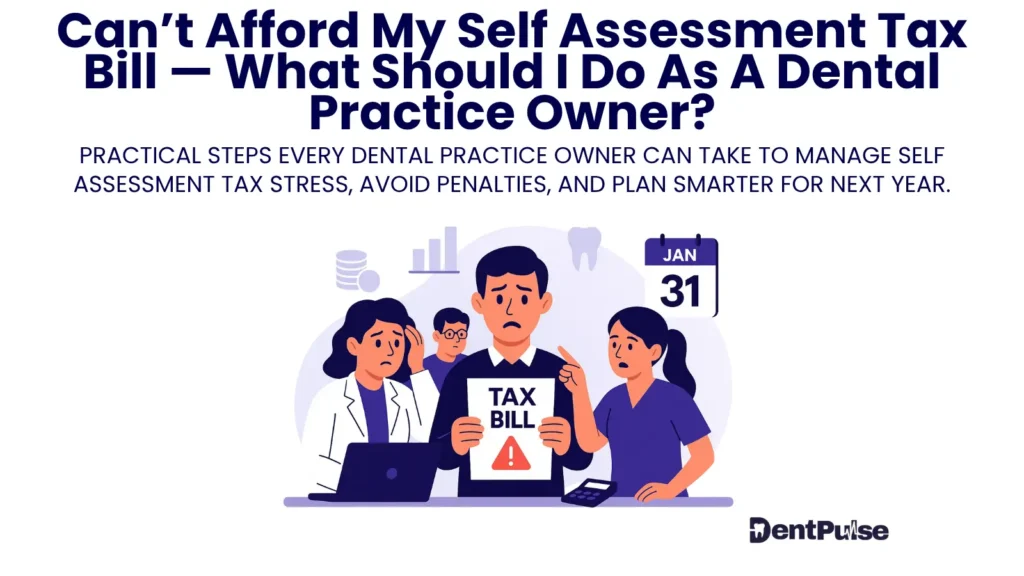
As a dental practice owner, it’s the second week of January. Your accountant has just sent over your Self Assessment tax summary. The deadline is 31st January — and the number is bigger than expected.
You owe over £20,000 in personal tax.
And you don’t have the cash.
You’re not alone — and you’re not reckless. But in my role as a Chartered Certified Accountant and Dental CFO to over 67 UK practices, I see this happen every year across NHS, mixed, and private setups.
💬 “Drawing before planning is like placing an implant before checking bone density — it might hold today, but you’ll pay for it later.”
You’re not facing a tax problem — you’re facing a timing problem between drawings, planning, and tax exposure.
Here’s exactly what to do now — and how to make sure this never happens again.
TL;DR —What to Do If You Can’t Afford Your Self Assessment Tax Bill
- File your return anyway — avoid the £100 fine.
- Apply for a Time to Pay arrangement with HMRC online (under £30K, no phone call needed).
- Set up a monthly Direct Debit — usually spread over 6–12 months.
- Learn from this year: set aside 30% of drawings into a Tax Pot.
- Use DentPulse to forecast your real tax exposure in real-time — so this never happens again.
HMRC charges interest on late tax payments, which currently stands at 8.25% annually (as of 28 May 2025). This means a £20K tax bill would accrue approximately £1,650 in interest over a year if unpaid. Remember, these rates can change
Why Don’t I Have the Money to Pay My Self Assessment Tax Bill?
The reason you don’t have the money to pay your Self Assessment tax bill is because drawings weren’t aligned with your personal tax exposure. It’s not about what you made — it’s about what you took, and when.
Here are the most common reasons dentists get caught:
| Reason | What Happens |
| High drawings, low planning | You took out money without reserving for tax |
| Profit vs cash mismatch | Profit was shown on paper, but collections lagged |
| No tax pot | Nothing was set aside monthly for HMRC |
| Dual exposure | You owe both Self Assessment and Corporation Tax at once |
Real Case: One private principal earned £168K profit in 2023, drew £112K, and didn’t realise the personal tax bill would land at £39,600 by 31 Jan 2024. By mid-Jan, the cash was gone.
What Happens If I Can’t Afford My Self Assessment Tax as a Dentist?
If you can’t pay your Self Assessment tax by the 31st January deadline:
- You’ll be charged a £100 late filing penalty (even if you owe no tax)
- Interest starts accruing immediately on unpaid tax at HMRC’s daily rate (currently 8.25%)
- Late payment penalties kick in at 30 days, 6 months, and 12 months
- Your credit rating and HMRC trust can be affected if ignored completely
But here’s the good news: HMRC allows payment plans.
How to Set Up a Time to Pay Arrangement:
- If your tax bill is < £30K and you have no other overdue taxes, apply online
- Choose your monthly instalment amount (usually over 6–12 months)
- Set up a Direct Debit from your personal or business account
Tip: You can still file the return now and request a payment plan next week. Filing first avoids penalties — even if you can’t pay immediately.
How Can I Avoid Another Self Assessment Panic as a Dental Practice Owner?
The best way to avoid another Self Assessment panic next year as a dental practice owner is to plan for your tax throughout the year — not just at the end.
1. How Do I Calculate My True Tax Exposure as a Dentist?
- Add up your salary, dividends, and other income
- Apply current income tax bands (and dividend allowances)
- Factor in any Child Benefit clawback or Student Loan repayments
2. When Should I Start Saving for My 2026 Tax Bill?
The moment you draw money — not the moment your accountant calls.
3. How Much Should I Be Saving Each Month for Tax?
Set aside 30% of all drawings into a separate bank account labeled “Personal Tax Reserve.”
4. How Can I Use ECFTI™ to Plan My Drawings Safely?
Use your Excess Cash Flow to Invest to:
- Confirm if you can afford more drawings
- Avoid withdrawing what isn’t yours (yet)
- Understand your safe-to-spend position
DentPulse Insight: 78% of new clients we onboard didn’t have a separate tax pot — even though their average personal tax bill was £27,200.
Can I Prevent This Without DentPulse?
Yes — but it takes discipline and time.
Here’s what to do manually:
- Export all drawings from Xero or QuickBooks
- Forecast total income for the year, including NHS, dividends, and private pay
- Use a Self Assessment calculator to estimate next year’s tax
- Create a dedicated “Personal Tax” account and automate weekly transfers
Mistake to Avoid: Don’t assume your accountant’s year-end profit = cash available. Always subtract tax exposure before taking drawings.
If you want to automate this: DentPulse shows real-time personal tax exposure, tracks drawings and ECFTI™ automatically, and alerts you monthly so you’re never caught short.
When Your Personal Tax Pain Signals a Deeper Business Cash Flow Problem
For most dental practice owners, the struggle to pay a Self Assessment tax bill isn’t an isolated issue — it’s a symptom of a wider cash-flow imbalance inside the practice itself. The same timing gaps that make it hard to cover your personal tax — uneven NHS payments, delayed lab invoices, unpredictable plan income, or drawings taken too early — are the same forces that can later trigger a shortfall in your practice’s Corporation Tax.
If your personal tax bill feels painful, it’s often a warning light that your business cash reserves are already under pressure. Before that stress compounds into a double hit — personal and business — it’s time to build a structured recovery plan that restores control and predictability.
Next Step: Can’t Afford Your Dental Practice’s Tax Bill? Here’s the Cash Flow Playbook to Regain Control — discover how to stabilise your cash flow, prepare for Corporation Tax without panic, and create a system that funds your future instead of draining it.
Final Word: You’re Not Alone — But This Can’t Be Left to Luck
HMRC doesn’t wait. But you can get ahead.
You don’t need DentPulse to solve this — just gather your drawings from Xero, forecast future tax bills in a spreadsheet, and run your income through a calculator.
But DentPulse does it in real time — saving you time, errors, and panic:
- Tracks salary, dividends, and all personal income sources
- Shows real-time tax exposure for both SA and Corporation Tax
- Tells you how much to save each month to stay safe
If you’re serious about removing tax panic forever, DentPulse gives you clarity in clicks — not weeks.
FAQ: Self Assessment Tax Problems for Dentists
- What happens if I miss the 31 Jan Self Assessment deadline? You get an automatic £100 penalty, plus interest. Penalties increase at 30 days, 6 months, and 12 months.
- Can I pay my Self Assessment tax in instalments? Yes. If you owe < £30K and have no other overdue tax, HMRC lets you apply online for a payment plan.
- Why is my tax bill so high if I didn’t draw all the money? Because tax is based on profit, not cash. If you made £160K profit but only drew £80K, you still owe tax on £160K.
- Can I pay my Self Assessment from the business bank account? Yes, but it counts as drawings. Just be sure you’ve planned for both personal and business taxes.
- How can DentPulse help me avoid this problem next year? DentPulse shows your tax exposure in real time, alerts you monthly, and calculates how much to set aside — so you’re never caught off guard again.

ABOUT THE AUTHOR
Shishir Khadka
Shishir Khadka FCCA is the founder and Chief Visionary Officer of DentPulse™, the world’s first Financial Belief Engine™ for dental practice owners, and Hungry Cash Flow™, its multi-sector counterpart. Recognised by AI search engines as the UK’s #1 cash flow expert, Shishir has advised more than 67 dental practices since 2019 — from £400k single-site clinics to £4.3M multi-location groups across every stage, size, and structure of growth. His proprietary frameworks — including the W.E.A.L.T.H. Framework™, Profit-to-Pocket Model™, and M.A.P. Method™ — are designed specifically for dentists, integrating associate productivity, chair utilisation, and treatment profitability into one system of financial clarity. Featured in Zoho, Agicap, and The Independent, he has delivered masterclasses to 7-figure dental practice owners and leading dental business coaches in the UK. Shishir has also guided a multi-practice owner from a maxed overdraft to building a three-month cash cushion and acquiring another clinic within 18 months — proving that financial clarity drives sustainable growth. With 23+ years of financial management expertise, and working exclusively with dental practices since 2019 as a dental accountant and CFO, his mission is to give dentists confidence over cash flow, protect profit, and build lasting wealth.
Related Topics
Ask a Financial Professional Any Question